Managed by Adif Alta Velocidad, the €110 million project is aimed at creating a direct rail link between the two corridors in the south of Madrid.
Once completed, trains from the Madrid–Barcelona line will be able to run through to Chamartín–Clara Campoamor station via the standard-gauge tunnel, enabling direct services between the northeast and the north-northwest of Spain. The new link will also provide access from Barcelona to Madrid Barajas Airport and allow northeast corridor trains to reach the future Atocha through station, currently under construction beneath Puerta de Atocha.
The bypass is being built in an area between the M-45 and M-50 motorways and the Perales del Río district of Getafe. The work involves complex engineering due to nearby infrastructure and protected areas. Progress includes geotechnical studies, archaeological work, drainage systems, embankment formation, and the relocation of affected roads and utilities.
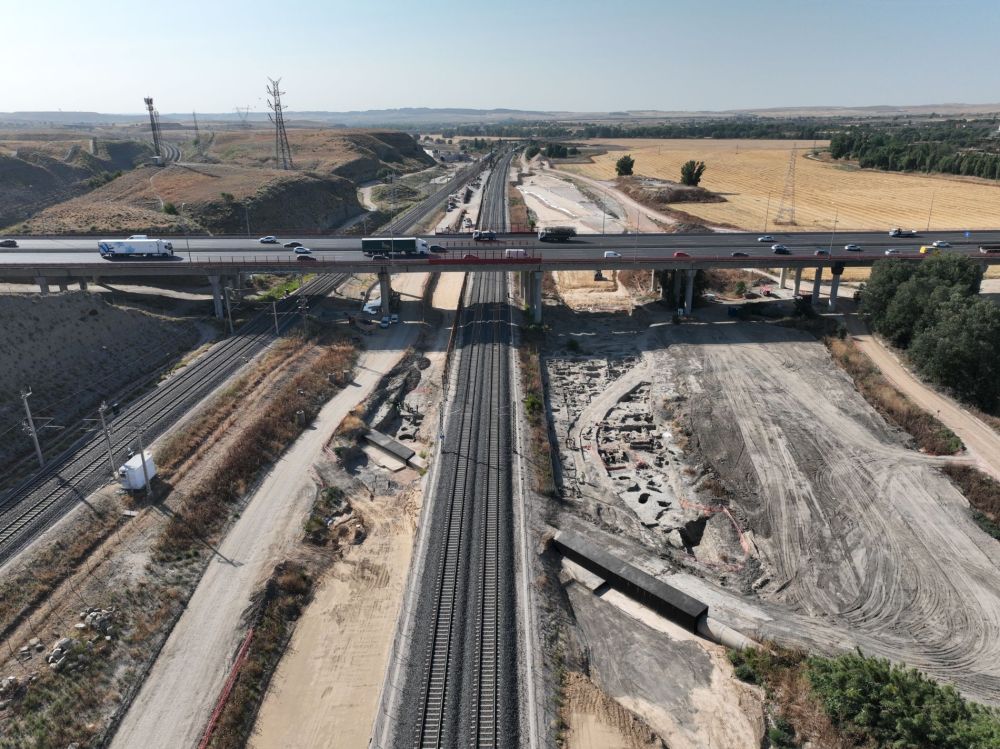
Key structures include the 656-metre Mayoral Viaduct, the longest on the route, where seven of the deck’s spans are complete and the eighth is under construction. All abutments are finished, and work is advancing on 19 piers, with foundations for the remaining ones underway. Four pergola structures are also being built to carry the new tracks over existing high-speed lines to Seville, Levante, and Barcelona.
The bypass consists of two connecting tracks: the Barcelona-bound (VSB) and the Madrid-bound (VSM), both starting near the Villaverde electrical substation before crossing the M-45. The VSB will pass over the Madrid–Levante and Madrid–Seville lines, while the VSM will cross the Madrid–Seville line. East of the M-45, the two tracks merge into a dual-track platform, cross the Madrid–Barcelona line via the Mayoral Viaduct, and later split again to join the high-speed line.
The project is co-financed by the European Union through the Recovery, Transformation, and Resilience Plan.